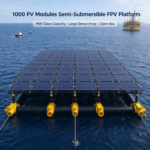
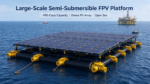
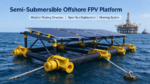
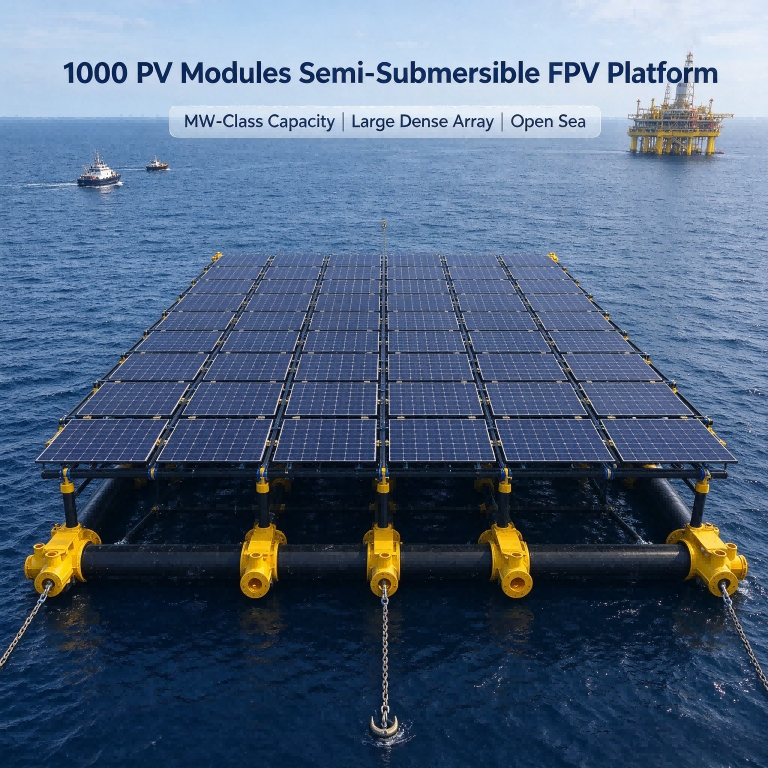
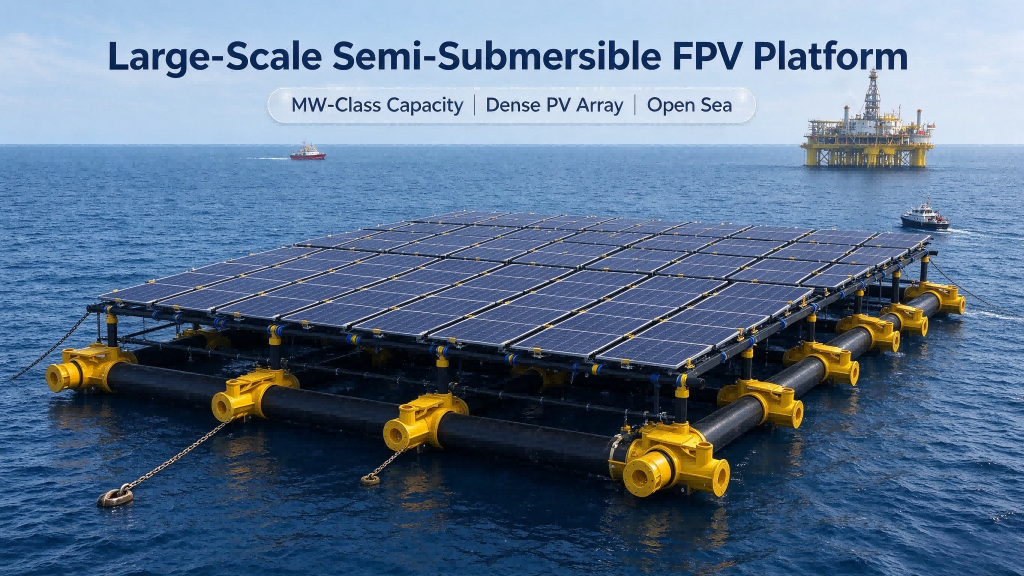
Heavy-duty semi-submersible floating offshore PV system designed for open-sea oil & gas platform power supply. Survives 6.5m wave, 34m/s wind and 4.6m tidal range. Modular from 500kW to 5MW per platform. Hybridizes with aeroderivative gas turbine and BESS to form a stable offshore microgrid, cutting fuel consumption by 25–45%. Full EPC turn-key service including mooring design, tow-out, cable laying and O&M.
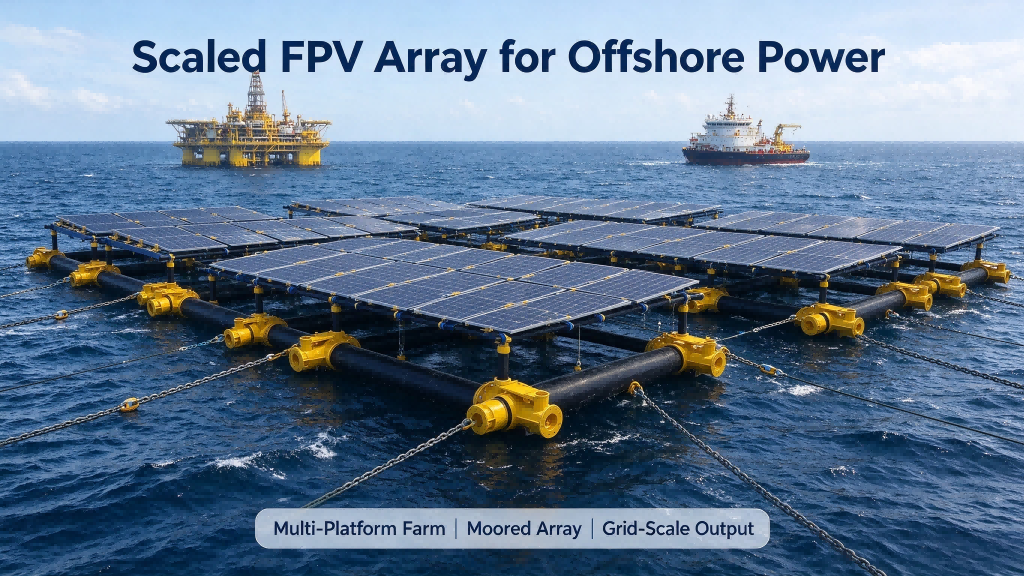
Semi-Submersible Offshore Floating PV for Oil & Gas Platform
- 1. **Offshore-Grade Survivability**
- Designed for 6.5m wave, 34m/s typhoon wind and 4.6m tidal range — not lake-grade floating solar.
- 2. **Hybrid Microgrid Ready**
- PV + BESS + aeroderivative gas turbine integration, cuts fuel consumption by 25–45%.
- 3. **Modular 500kW–5MW Scalable**
- Start with pilot, expand to multi-platform array. Tow-out installed in days, no offshore crane needed.
- 4. **Offshore Engineering Standards**
- Shipbuilding-grade steel, ICCP cathodic protection, marine-grade components, 25-year design life.
- 5. **Full EPC Turn-Key Service**
- Metocean survey, mooring design, fabrication, tow-out, submarine cable, commissioning and long-term O&M.
Semi-Submersible Offshore Floating PV for Oil & Gas Platform
Heavy-duty semi-submersible floating offshore photovoltaic system designed for open-sea oil & gas platform power supply. Survives 6.5m significant wave height, 34m/s wind speed and 4.6m tidal range. Modular from 500kW to 5MW per platform. Can be hybridized with aeroderivative gas turbine and BESS to form a stable offshore microgrid. Full EPC turn-key service: site survey, mooring design, platform fabrication, tow-out, installation, commissioning and O&M.
Get A Quote
Share your platform location, water depth, wave data, annual sunshine hours and current fuel consumption. We will provide preliminary hybrid microgrid design within 48 hours.
Product Introduction
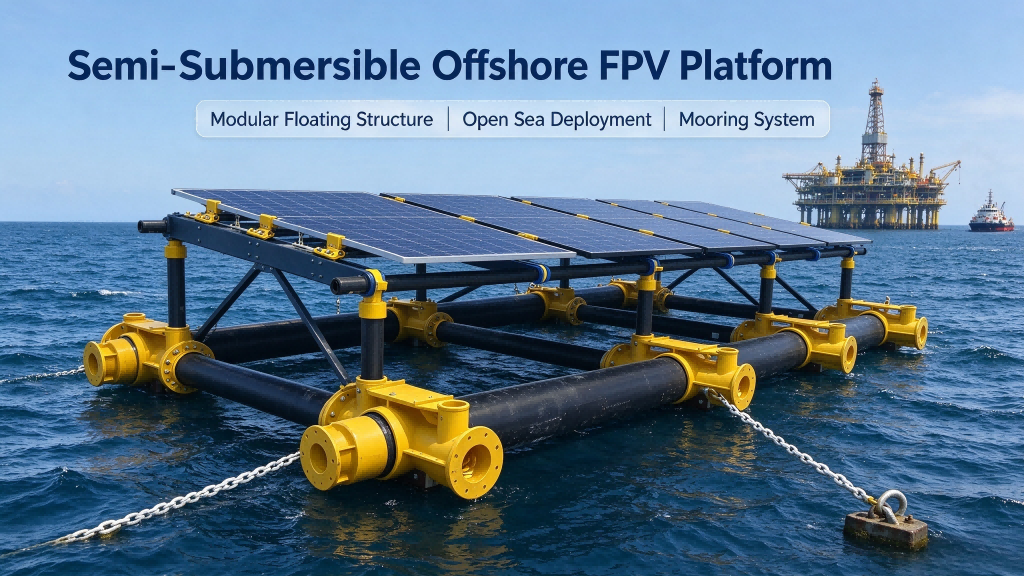
This semi-submersible floating offshore PV system adopts shipbuilding-grade steel truss structure with column-stabilized semi-submerged hull, inheriting offshore oil & gas platform engineering standards. Unlike ordinary HDPE floating solar designed for calm inland lakes, this system is engineered for open sea with strong waves, typhoons and large tidal range.
The platform carries anti-salt-fog double-glass PV modules, string inverters, step-up transformer and MV switchgear on deck. Power is transmitted via submarine cable to the nearby oil & gas platform or onshore substation. It is ideal for reducing diesel/gas turbine fuel consumption on offshore facilities, cutting OPEX and Scope 1/2 emissions for energy operators.
Key Performance at a Glance
6.5 m
Survivable Wave Height
34 m/s
Design Wind Speed
5+ m
Minimum Water Depth
500kW–5MW
Modular Capacity
Core Technical Parameters
| Item | Specification |
|---|---|
| Platform Type | Semi-submersible steel truss platform, column-stabilized, shipbuilding-grade corrosion protection |
| Modular Capacity | 500 kW / 1 MW / 2 MW / 5 MW per platform; multi-platform array up to tens of MW |
| PV Module | 550–620 W bifacial double-glass mono PERC / N-type TOPCon, anti-salt-fog, anti-corrosion frame |
| Inverter | Marine-grade string inverter, IP65, conformal coating, anti-salt-fog treatment |
| Survivable Wave Height | 6.5 m significant wave height |
| Design Wind Speed | 34 m/s (typhoon class) |
| Tidal Range Adaptation | Up to 4.6 m |
| Water Depth Range | 5 m – 50 m (deeper water available on request) |
| Mooring System | Catenary / taut-leg mooring with chain + polyester rope; drag-embedded anchors or suction piles |
| Deck Equipment | Inverter room, step-up transformer, MV switchgear, emergency egress, fire-fighting system |
| Power Export | 35 kV / 66 kV submarine cable to platform or shore substation |
| Corrosion Protection | Marine-grade epoxy coating + impressed current cathodic protection (ICCP) |
| Design Lifetime | 25 years (structure); 25-year linear power warranty on modules |
| Monitoring | Real-time wave, motion, power output, anchor load monitoring; remote O&M center |
Why Semi-Submersible for Offshore Oil & Gas
Structural Advantages
- Offshore-grade stability: Semi-submerged hull cuts wave-induced motion by 60–70% vs. flat HDPE floaters; inverters and transformers operate reliably.
- Typhoon survival: Designed to survive category-typhoon conditions without dismantling modules.
- Large deck payload: Can carry transformers, switchgear, BESS containers and even small hydrogen electrolyzers on deck.
- Tow & install: Fully assembled onshore, towed to site, connected in days — no offshore crane needed.
- Scalable: Start with 1MW pilot, expand to multi-platform array as field matures.
Business Advantages for Operators
- Fuel saving: Offset 20–40% of platform gas turbine / diesel generator running hours.
- Emission reduction: Directly cuts Scope 1 & 2 emissions, supports net-zero targets for E&P majors.
- OPEX reduction: No fuel transport cost; PV has near-zero marginal operating cost.
- Hybrid-ready: Seamlessly integrates with existing gas turbine genset and BESS on platform.
- Regulatory compliance: Meets offshore environmental regulations on produced-water, discharge and emissions.
Typical Application Scenarios
Offshore Production Platform Power Offset
Floating PV array 1–3 km from platform, submarine cable feeds into platform MV bus. Reduces gas turbine fuel burn during daytime peak solar hours.
Offshore Wellhead / Remote Satellite Platform
Smaller 500kW–1MW semi-sub platform powers unmanned wellhead platforms, eliminating diesel generator maintenance visits.
Offshore Green Hydrogen / Green Methanol Island
Large PV array + electrolyzer on same semi-sub deck. Power consumed on-site, no long submarine cable needed. Ideal for coastal export-oriented green fuel projects.
Offshore Accommodation / Living Quarters Power
Dedicated PV array supplies living quarters, galley and HVAC loads during day, cutting platform gas turbine runtime.
Hybrid Microgrid Integration with Gas Turbine
The real value for offshore operators is not solar alone — it is a hybrid microgrid: PV + BESS + gas turbine working together. Solar provides cheap daytime energy; BESS smooths intermittency and provides ride-through; the aeroderivative gas turbine (7MW / 25MW class) handles night load, cloudy days and black start.
- Daytime: PV covers base load, gas turbine reduces to minimum or shuts down.
- Cloud transients: BESS injects power in <20ms to keep voltage stable.
- Night / low sun: Gas turbine picks up full load efficiently.
- Result: 25–45% fuel saving vs. running gas turbine 24/7 on pure diesel/gas.
O&M & Maintenance
Routine Maintenance Schedule
- Quarterly: Remote performance check, wave/motion data review, anchor load inspection.
- Half-yearly: Vessel visit, module visual inspection, inverter filter cleaning, cable check.
- Annually: Diver ROV inspection of mooring chains and hull coating; transformer oil test.
- Every 5 years: Cathodic protection inspection, anti-fouling check, major bolt torque survey.
Maintenance Highlights
- Marine-grade components minimize salt-fog corrosion failures.
- Remote monitoring platform detects underperforming strings within hours.
- Mooring system designed for 25-year life with 10-year chain replacement cycle.
- We provide O&M vessel support and spare parts supply as part of EPC scope.
- Designed for minimum manned intervention — no personnel on deck during normal operation.
ROI & Payback Period
| Scenario | Fuel Saving | Typical Payback |
|---|---|---|
| Platform gas turbine offset (Middle East / Southeast Asia, high DNI) | 30–45% fuel reduction | 5–7 years |
| Diesel generator offset (remote wellhead, high diesel price) | 40–60% fuel reduction | 4–6 years |
| Green hydrogen / methanol on-site (subsidized carbon credit) | Power cost saving + green product premium | 6–9 years |
| Norwegian / North Sea (lower DNI, high carbon tax) | 20–30% fuel + carbon tax saving | 7–9 years |
Exact payback depends on local irradiance, diesel/gas price, carbon tax and EPC cost. We provide a customized financial model with your project data.
Frequently Asked Questions
Q1: How is this different from ordinary floating solar on lakes?
Ordinary HDPE floating solar is designed for calm inland lakes with waves under 0.5m. This semi-submersible steel platform is engineered for open sea: 6.5m wave survival, 34m/s typhoon wind, shipbuilding-grade corrosion protection and mooring design. It uses offshore oil & gas engineering standards, not freshwater pond standards.
Q2: What water depth is required?
Minimum 5m. The system works in 5–50m water depth with catenary mooring; deeper sites can use taut-leg mooring. It is not suitable for shallow intertidal mudflats — those use pile-fixed offshore PV instead.
Q3: How is power transmitted to the platform?
On-deck inverter converts DC to AC, step-up transformer raises voltage to 35kV or 66kV, then a submarine dynamic cable transmits power to the platform’s MV switchgear. Cable length typically 1–10 km. We provide cable routing design and installation.
Q4: Can it work together with our existing gas turbine?
Yes. This is our recommended configuration. The PV+BESS hybrid system interfaces with your existing platform power management system (PMS). Solar covers daytime load, BESS smooths intermittency, gas turbine handles the rest. We provide control system integration and communication protocol (Modbus / IEC 61850) support.
Q5: How long does installation take?
Platform is fully assembled and pre-commissioned onshore at fabrication yard, then towed to site. Typical installation: mooring in 1–2 weeks, cable laying 1–2 weeks, commissioning 1 week. Total offshore work under 4 weeks for a 5MW array.
Q6: What about typhoons and extreme storms?
The platform is designed to survive category-typhoon conditions (34m/s wind, 6.5m wave) without damage. Modules stay mounted; mooring system is sized to 100-year return period storm. For extreme events beyond design, we provide deballast and storm-prepared remote shutdown procedure.
Q7: Do you provide EPC or just equipment?
We provide full EPC turn-key: site metocean survey, mooring & hydrodynamic analysis, platform fabrication, tow-out, cable laying, interconnection with platform PMS, commissioning and 5-year O&M. We can also supply equipment-only if you have your own EPC partner.
Q8: What is the typical payback period?
In high-DNI regions (Middle East, Southeast Asia, Caribbean) with high diesel/gas prices, payback is 4–7 years. In lower-sunlight regions (North Sea, with high carbon tax), payback is 7–9 years. We provide a customized financial model after receiving your project data.
Start Your Offshore PV Project
Share platform location, water depth, wave data, fuel cost and annual sunshine. Our engineering team will reply with preliminary hybrid microgrid design within 48 hours.


Get in touch
Enter your serial number so we can connect you to the original dealer for support, repairs and warranty requests.
Get in-depth on-line training about our products and solutions by Victron experts. Create a free Victron Professional account to join trainings, see firmware changelogs and get access to all the other expert know-how and tools.