
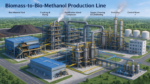
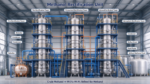
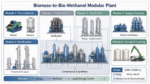
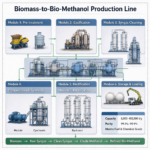
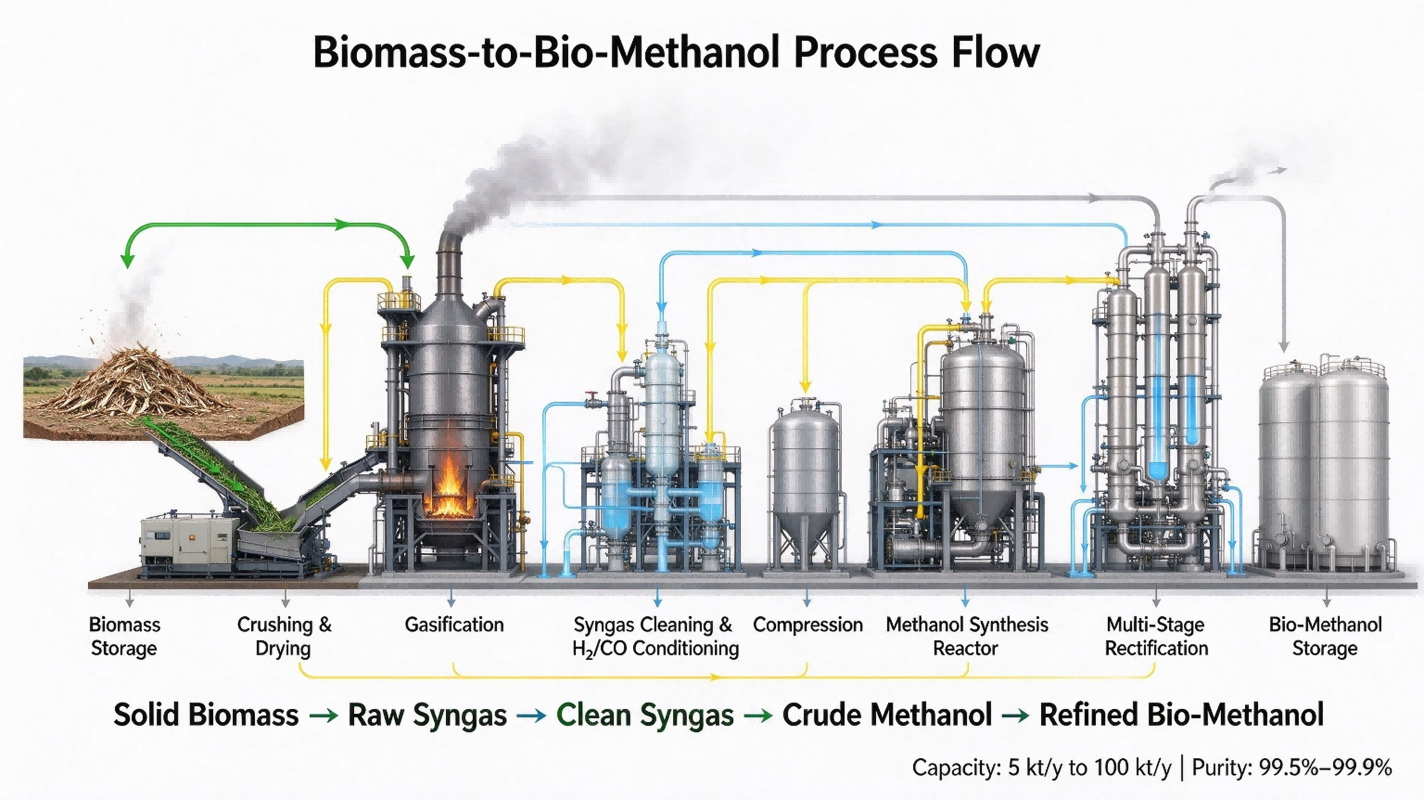
Biomass-to-Bio-Methanol plant is a complete turnkey EPC production system rather than a single machine. It converts low-cost solid biomass feedstock (wood chips, palm EFB, straw, agricultural residues) into high-purity renewable bio-methanol via biomass gasification, syngas purification, H₂/CO ratio adjustment, catalytic synthesis and multi-stage rectification. The finished bio-methanol can reach marine bunkering grade, supports ISCC carbon certification, and serves as a low-carbon alternative to fossil methanol for shipping, chemical manufacturing and power generation.
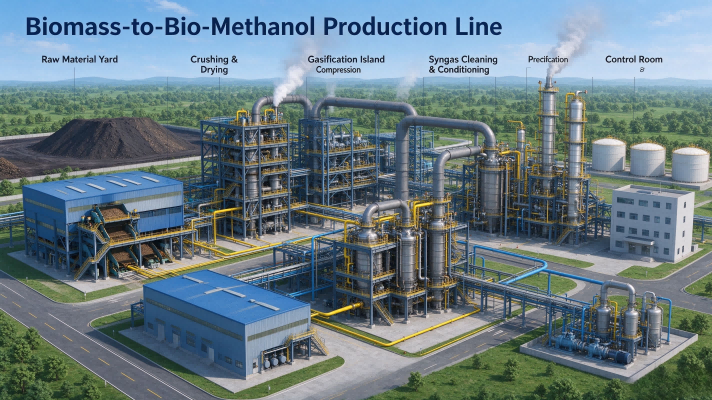
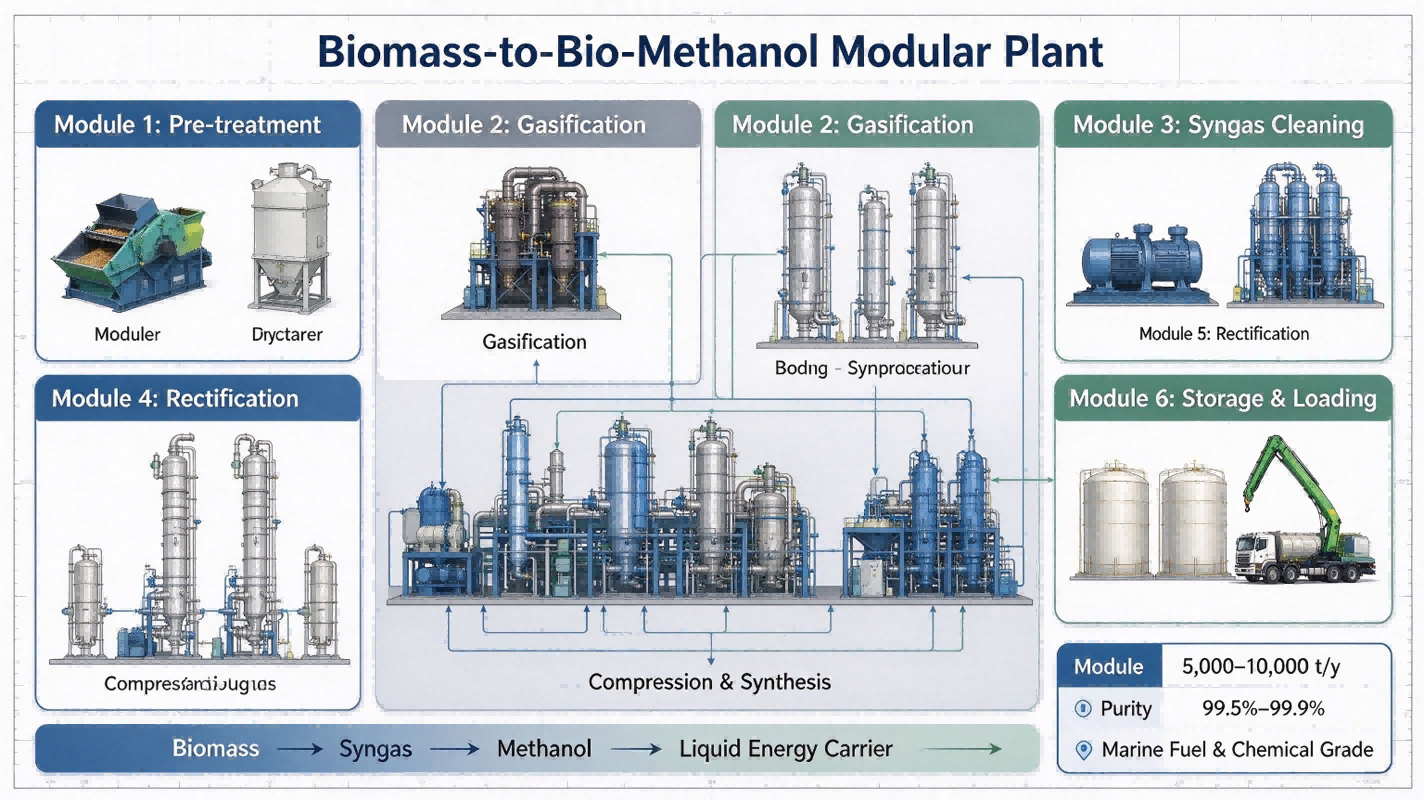
Biomass-to-Bio-Methanol Production
- 1. **Wide Feedstock Adaptability**
- Compatible with wood chips, sawdust, palm empty fruit bunches, crop straw and bagasse; raw materials can be ISCC-certified for carbon credit trading.
- 2. **Modular Turnkey EPC Solution**
- Prefabricated modular design, flexible capacity from 5,000 tpy to 100,000 tpy; short construction cycle and easy on-site assembly.
- 3. **High-Purity Grade Output**
- Three optional product grades: industrial grade ≥99.5%, fuel grade ≥99.7%, marine bunkering grade ≥99.9%.
- 4. **Internal Waste Heat Integration**
- Waste heat from gasification and synthesis is recycled to supply heat for drying and distillation, greatly reducing external energy consumption.
- 5. **Low Carbon & Circular Economy**
- Tail gas recycled for heating; ash by-product can be used as bio-fertilizer. Fully compliant with IMO and EU low-carbon emission regulations.
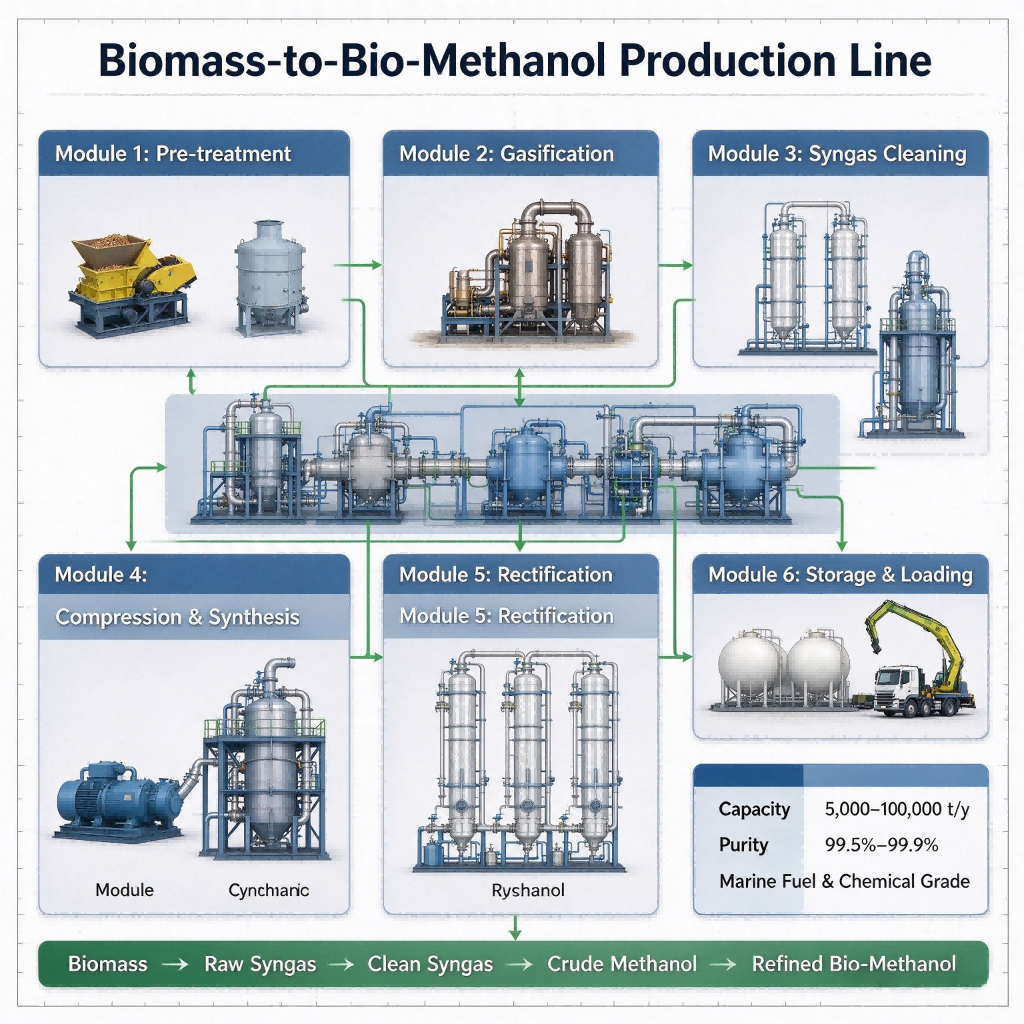
Biomass-to-Bio-Methanol Production Line
This is a complete integrated EPC production system, NOT a single standalone machine. It converts low-cost solid biomass feedstock (wood chips, palm EFB, straw, agricultural residues) into high-purity renewable bio-methanol through gasification, syngas cleaning, H₂/CO ratio adjustment, catalytic synthesis and multi-stage distillation. The finished bio-methanol can reach marine bunkering grade and supports ISCC carbon certification, serving as a low-carbon substitute for fossil methanol for shipping, chemical manufacturing and power generation. This page contains full investment data, raw material consumption and supply assessment for your project feasibility study.
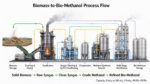
5-Stage Production Process
- Biomass Pre-treatment Unit: Crushing, screening, drying to control moisture below 15% and particle size ≤10mm.
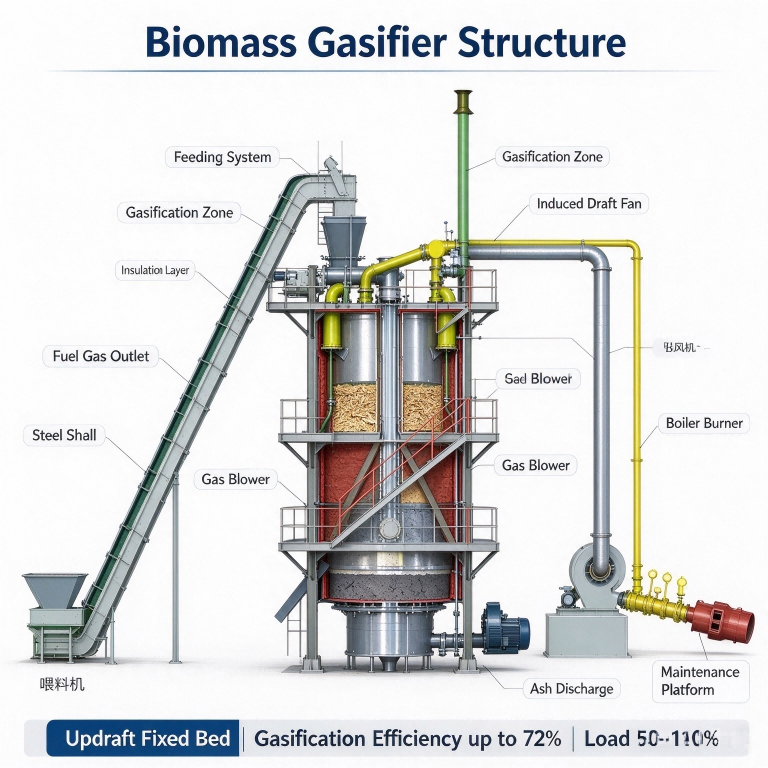
- Biomass Gasification Unit: Updraft fixed-bed gasifier turns wood chips, straw, palm husk into raw syngas (CO, H₂, CO₂).
- Syngas Purification & Conditioning Unit: Tar removal, dust filtration, desulfurization, water-gas shift reaction to adjust hydrogen-carbon ratio to 2:1 for methanol synthesis.
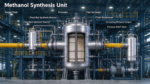
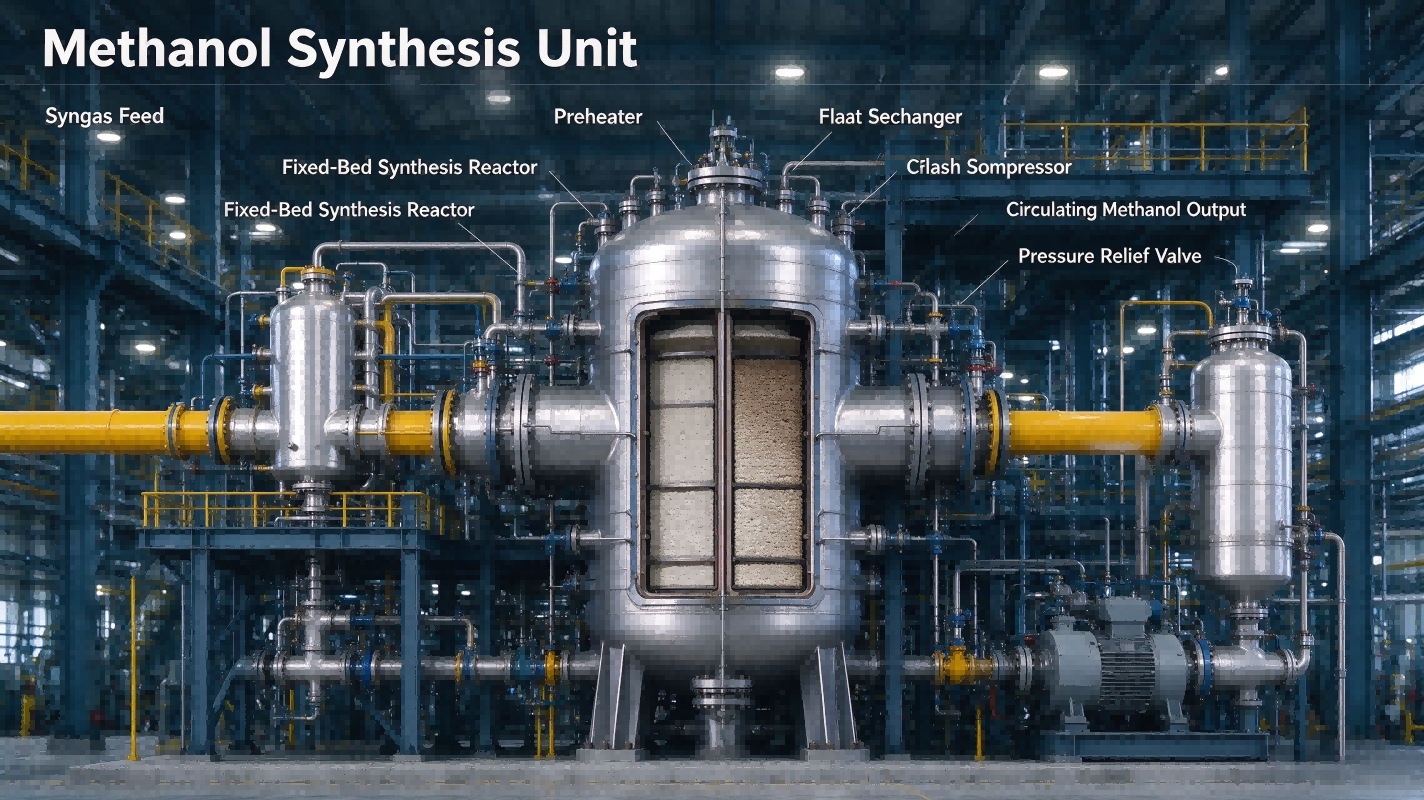
- Methanol Synthesis Unit: Compressed qualified syngas enters fixed-bed synthesis reactor under high pressure, catalytic reaction produces crude methanol.
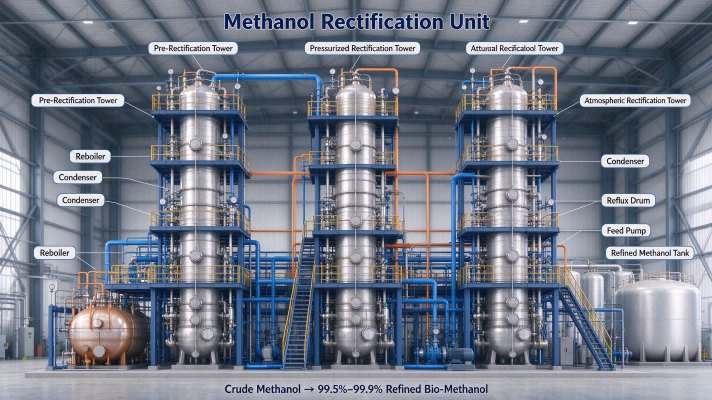
- Multi-stage Rectification Unit: Pre-distillation + atmospheric distillation tower, purify crude methanol to 99.5%~99.9% high-purity bio-methanol.
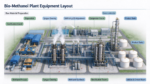
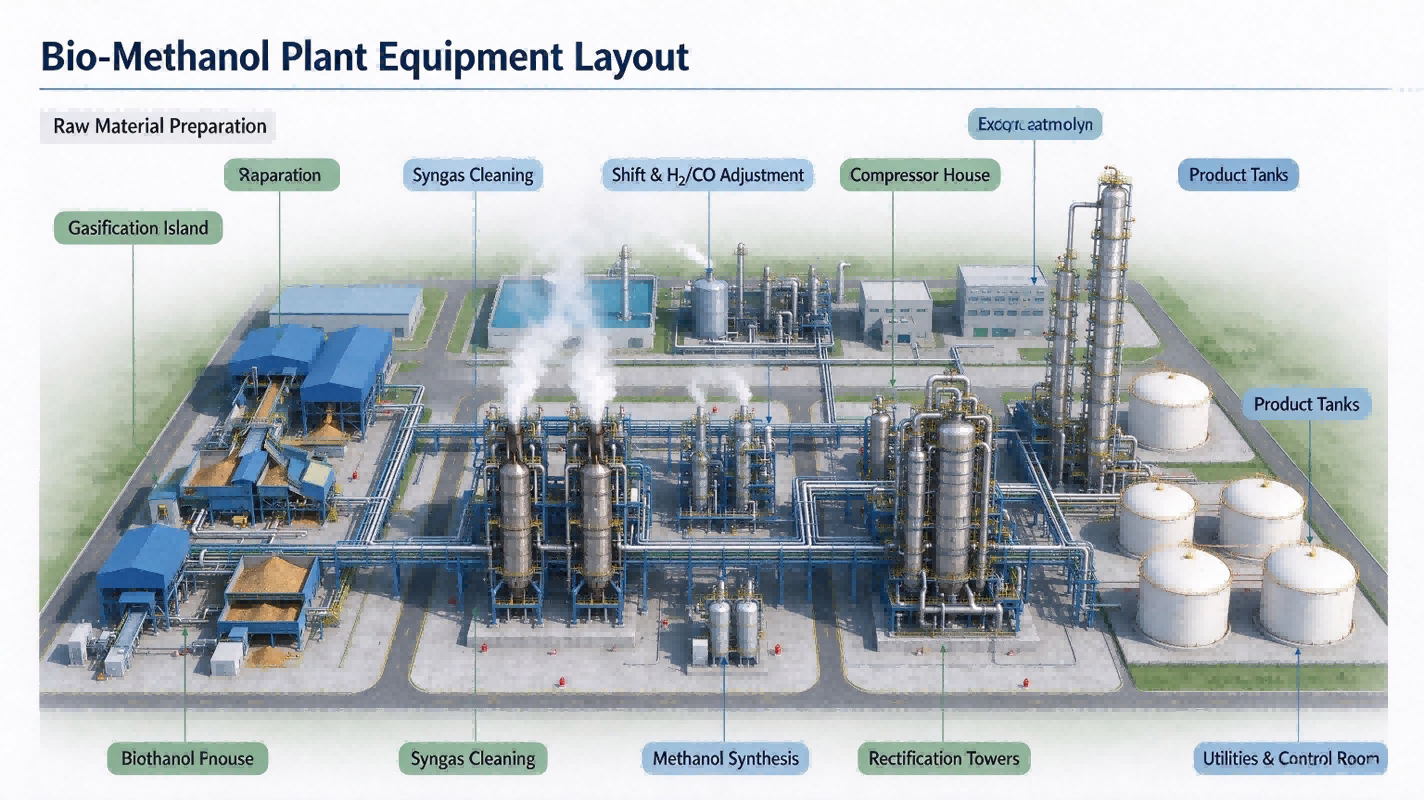
Full Equipment List of the Production Line
| Unit Section | Key Equipment |
|---|---|
| Raw Material Preparation | Wood crusher, vibrating screen, rotary dryer, belt conveyor, automatic feeding machine |
| Gasification Island | Updraft biomass gasifier, air blower, ash discharger, water seal system |
| Syngas Cleaning & Conditioning | Cyclone dust collector, tar reformer, desulfurization tower, water-gas shift reactor, PSA carbon removal device |
| Compression & Synthesis | Syngas reciprocating compressor, preheater, methanol synthesis reactor, heat exchanger, flash separator |
| Methanol Rectification | Pre-rectification tower, pressurized rectification tower, atmospheric rectification tower, reboiler, condenser, product storage tank |
| Public Engineering | PLC automatic control system, circulating cooling water system, waste heat recovery boiler, tail gas recycling system |
Production Capacity & Technical Parameters
| Item | Small Pilot Plant | Medium Industrial Plant | Large Commercial EPC Plant |
|---|---|---|---|
| Annual Operation Hours | 7200 h | 8000 h | 8000 h |
| Biomass Feed Consumption | 3 t/h | 15 t/h | 35 t/h |
| Annual Bio-Methanol Output | 5,000 tons/year | 25,000 tons/year | 80,000 ~ 100,000 tons/year |
| Methanol Purity | ≥99.5% (Industrial Grade) | ≥99.7% (Fuel Grade) | ≥99.9% (Marine Bunkering Grade) |
| Syngas H₂:CO Ratio | 2.0 ~ 2.05:1 | 2.0 ~ 2.05:1 | 2.0 ~ 2.05:1 |
| Synthesis Operating Pressure | 5.5 ~ 6.0 MPa | 5.5 ~ 6.0 MPa | 5.5 ~ 6.0 MPa |
| Total System Carbon Conversion Efficiency | ≥42% | ≥45% | ≥48% |
| Control Mode | Semi-automatic | Fully automatic PLC | DCS central automatic control |
Investment Scale & Payback Period Reference
| Plant Scale | Annual Methanol Output | EPC Total Investment (USD, excluding land & utility) | Static Payback Period |
|---|---|---|---|
| Small Pilot Plant | 5,000 tpy | $400,000 – $700,000 | 6–10 years (without carbon credit); 5–7 years with ISCC carbon revenue |
| Medium Industrial Plant | 25,000 tpy | $2,800,000 – $5,500,000 | 7–10 years (pure methanol sales); 5–7 years with carbon credit |
| Large Commercial Plant | 80,000–100,000 tpy | $11,000,000 – $20,000,000 | 6–9 years (pure methanol sales); 4–6 years with free self-owned biomass + carbon credit |
Note: Investment covers equipment, installation, commissioning and DCS control. Land, site infrastructure, financing cost and local permit fees are excluded. Raw material cost accounts for 60~70% of total operating expense, which is the core factor affecting project profit.
Raw Material Scope, Consumption & Supply Capacity Requirements
Raw material available: Wood chips, sawdust, forest residues, wheat straw, rice straw, palm EFB / palm shell, bagasse, bamboo chips and fruit shell waste. Woody biomass is the preferred feedstock for stable operation.
Material consumption ratio: 2.5 ~ 3 tons of dry biomass (moisture ≤15%) to produce 1 ton of bio-methanol.
| Plant Scale | Daily Dry Biomass Demand | Economic Collection Radius | Minimum Stockpile Requirement |
|---|---|---|---|
| 5,000 tpy | 35–42 ton/day | ≤50 km | 15~30 days inventory |
| 25,000 tpy | 175–210 ton/day | 80–100 km | 15~30 days inventory |
| 80,000–100,000 tpy | 700–840 ton/day | 100–150 km | 15~30 days inventory |
- Raw material inlet moisture: Controlled ≤15% after drying; high moisture feedstock will increase drying energy consumption and reduce efficiency.
- Particle size: Crushed to 5–10 mm, with magnetic separation and screening to remove stones, metal and mud.
- Storage requirement: Covered yard to prevent rain and moisture fluctuation; stock area from 5,000 ㎡ to 20,000 ㎡ depending on scale.
- Key project risk reminder: The project viability mainly depends on stable, low-cost biomass supply within the collection radius, not only the technology itself.
Core Advantages
- Wide Feedstock Adaptability
Compatible with wood chips, sawdust, palm empty fruit bunches, crop straw and bagasse; raw materials can be ISCC-certified for carbon credit trading. - Modular Turnkey EPC Solution
Prefabricated modular design, flexible capacity from 5,000 tpy to 100,000 tpy; short construction cycle and easy on-site assembly. - High-Purity Grade Output
Three optional product grades: industrial grade ≥99.5%, fuel grade ≥99.7%, marine bunkering grade ≥99.9%. - Internal Waste Heat Integration
Waste heat from gasification and synthesis is recycled to supply heat for drying and distillation, greatly reducing external energy consumption. - Low Carbon & Circular Economy
Tail gas recycled for heating; ash by-product can be used as bio-fertilizer. Fully compliant with IMO and EU low-carbon emission regulations.
Main Application Scenarios of Bio-Methanol
1. Marine Bunkering Fuel: The primary low-carbon fuel for ocean-going vessels to meet IMO GHG emission reduction targets; widely used at Singapore, Rotterdam and Shanghai bunkering ports.
2. Chemical Raw Material: Feedstock for formaldehyde, DME, acetic acid, bioplastics and fine chemical production, replacing fossil coal-based methanol.
3. Power Generation Fuel: Clean fuel for gas turbines and internal combustion engines for off-grid power plants.
4. Transportation Fuel Additive: Blended into gasoline as a low-carbon oxygenated fuel for flex-fuel vehicles.
5. Green Hydrogen Carrier: Liquid at normal temperature, easy storage and tanker transportation, the most economical hydrogen carrier for renewable energy projects.
Frequently Asked Questions
Q1: Is this a single machine or a whole production line?
A1: It is a complete turnkey EPC production line, not a single machine. The biomass gasifier is only one core unit; the full set includes pretreatment, purification, synthesis and rectification subsystems.
Q2: What biomass materials can be used as raw materials?
A2: Woody biomass (wood chips, sawdust, tree branches) & agricultural residues (wheat straw, rice husk, palm EFB, bagasse). Raw material moisture must be controlled below 15% after drying.
Q3: What purity grades can we supply?
A3: Three grades: industrial grade (99.5%), fuel grade (99.7%), marine bunkering grade (99.9%). We can provide ISCC certification documents for carbon credit application.
Q4: Can we build a small-scale pilot plant first?
A4: Yes. We offer 5,000 tons/year pilot modular plants for test operation, then expand step-by-step to 25ktpy and 100ktpy commercial scale.
Q5: What is the main difference between biomass gasification for heating vs bio-methanol production?
A5: Heating gasification only produces crude syngas for direct combustion; bio-methanol production requires tar removal, desulfurization, H₂/CO ratio adjustment, high-pressure synthesis and multi-stage rectification, with much stricter gas purification requirements.
Q6: What is the payback period of the investment?
A6: For a 25,000 t/year medium plant with carbon credit income included, the static investment payback period is 5~7 years, depending on local biomass raw material cost and methanol market price. Without carbon credit revenue, the payback will extend to 7–10 years.
Q7: What is the biggest risk for this project?
A7: Stable raw material supply. The factory needs sustainable biomass supply within the economic collection radius. Rising transportation cost or raw material shortage will greatly affect project profitability.
Q8: What is the biomass consumption per ton of methanol?
A8: Approximately 2.5–3 tons of dry biomass (moisture ≤15%) for each ton of bio-methanol output.


Get in touch
Enter your serial number so we can connect you to the original dealer for support, repairs and warranty requests.
Get in-depth on-line training about our products and solutions by Victron experts. Create a free Victron Professional account to join trainings, see firmware changelogs and get access to all the other expert know-how and tools.